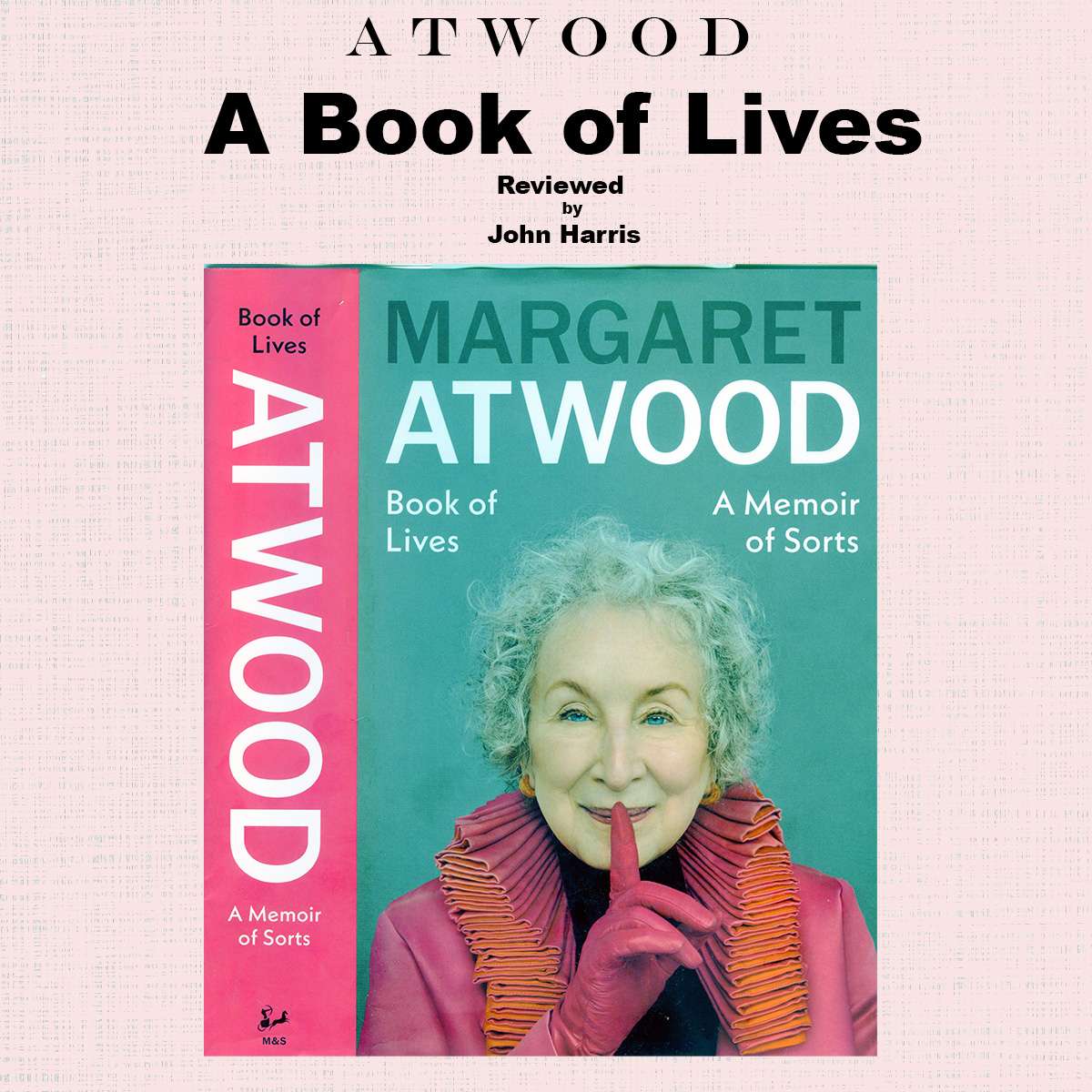
Memoir by Atwood
The book’s introduction explains why “lives” in the title is plural, and why the subtitle is “A Memoir of Sorts.” The explanation is confusing, but in an intriguing way.
You might think at first that “lives” is plural to account for all the lives intertwined with Atwood’s: parents, children, lovers, associates, other writers etc. A memoir of any sort would normally include these lives. But, as she explains it, “lives” applies to her lives, of which she has two, “the one who lives and the one who writes.”
Let’s call these living beings, or half-beings, in the name of referential efficiency, and respectively, Peggy and Margaret. And let’s refer, again in the name of efficiency, to their unified being as Atwood.
The one who writes, Margaret, uses two analogies to illustrate her relationship to Peggy. One analogy is that of the body double, or stunt-person, standing in for an actor. The stunt-person is specified to be Margaret, and so the actor is Peggy. Both wear the same outfits, but Margaret does the dangerous stuff — the writing, presumably.
Margaret’s other analogy is Dr. Jekyll and Mr. Hyde. She doesn’t say, directly, which of these is herself (Margaret) or which is Peggy. She just points out that Jekyll and Hyde “share a memory and even a wardrobe.”
They may share a memory, but not, Margaret says, 50 / 50: “the one doing the writing has access to everything in the memory bank. The one doing the living might have some idea of what the writing self has been up, but less than you’d think.”
Spoiler alert #1: This is Margaret talking, and she’s mistaken. Peggy is watching over Margaret’s shoulder as every sentence evolves, and is ever ready to grab the pen. She also has full access to the joint memory bank.
Margaret’s setting up a sort of Freudian dialectic here. Her sense of control over the memory bank makes her the super-ego. She is Jekyll, the good Doctor, an embodiment of the values that society teaches (sometimes more and sometimes less efficiently) to people from infancy. Jekyll wants to suppress Hyde, or instinct, the animal response to fear, passion and hate. Peggy is Hyde, the id, equally powerful. Atwood is the ego
Margaret says that her “sinister alter-ego” liked the idea of a memoir:
I could depict myself in a flattering light, casting a gauzy haze over my stupider or wickeder actions while blaming them on others. At the same time I could thank my benefactors, reward my friends, trash my enemies and pay off scores long forgotten by everyone but me . . . . But, I told myself, I wouldn’t have to confine myself to this kind of squalid moral bookkeeping. I could embark on a journey in search of my own authentic inner self, supposing there is such a thing.
Honestly put — Peggy seems to have had an equal hand in this, especially in the last phrase. Margaret promises that her memoir will be “warts and all,” a genuine search for that inner self.
Spoiler Elert #2: The search shows how Atwood, the ego, acquired her unusually accurate take on reality — how she became very good at harnessing and driving Margaret and Peggy, Jekyll and Hyde, safely, and at a steady pace, through life. The secret is, she develops a great sense of humour. The old truism, that she who thinks tends to see and experience life as a comedy, and she who feels tends to see and experience it as a tragedy, applies to Atwood’s life, novels and memoir.
Margaret complicates her dialectic by saying that, in the case of her and Peggy, they actually have more than two lives: “There are lots.” Saying that people have many lives is a cliché, and for Margaret to imply that she and Peggy have more lives than other people do could be considered pretentious. But Margaret seems to explain this when she says that “images” are projected on her: “a few concocted by me, but many — less positive and sometimes downright frightening — projected onto me by others.” This happens because Margaret is famous.
Spoiler Alert #3: Peggy reacts strongly against the less positive and scary images projected by others onto her alter-ego, and at the same time subverts Margaret’s attempt to project positive ones on herself. She helps keep the memoir honest.
These images, as described, are kind of like lives, but they manifest themselves only occasionally. Three are mentioned: the Medusa, the Witch, and (most threatening of all to men and radical feminists) what I’ll call the Margaret Thatcher — the Conqueror and Occupier of Male Space.
The few non-threatening images that Margaret has projected onto herself are not mentioned in the Introduction, but can be found later in the book. One is the girl guide, an image that Peggy takes as threatening because it is always directed at her.
So much for the title of the book. What about the subtitle? What sort of memoir will proceed on the basis of the author with an alter-ego and multiple personalities? Margaret and Peggy can’t agree on this. Margaret settles for the designation, “literary memoir,” but Peggy mocks the idea: “I wrote a book . . . I wrote a second book . . . I wrote another book. Dead boring.”
Peggy also thinks that a literary memoir would turn into an attempt to show that Margaret’s acclaimed writing emerged from their joint life, which was exciting enough as they experienced it, but would not work as the plot of a novel because it would bore anyone else.
That life featured prescription drugs only, and no betrayals, violence, or weirdness, all of which are features of Margaret’s novels. Atwood had great parents, great siblings, great partners (one a husband), great friends — also not common, to that extent, in the novels.
The childhood – youth section of the memoir is a sort of Norman-Rockwellian saga of growing up (mostly, and most memorably) in a northern-wilderness, lakefront world featuring kerosene lamps and wild animals. Atwood was healthy and smart, and grew capable of manipulating her two sides, which guaranteed that her good luck stayed with her. People tended to like her, and she was very capable of adapting. She also liked entertaining, forever putting on skits (she invents the story lines) and writing stories.
There’s a lot of jokes and witty asides. For example, Atwood remembers being given, at about age 6, a cookie shaped like a bunny. She doesn’t eat it and, when asked why, replies “I just wanted to talk to it.” She remarks in an aside, “My belief that I could communicate with inanimate objects — including, on occasion, people — persisted for years.”
As the novelist emerges, big swaths of the book present her literary life. Half the chapter titles include the titles of Margaret’s books; the necessarily chronological feature of the memoir (though it need not be dominant) comes to be marked by these book titles. Some parts of these parts of the book — stories of editors, publishers, assistants, promoters, and their editing, publishing, assisting and promoting — are “dead boring.” Margaret can’t make them interesting; Peggy gets bored. Friends are being rewarded, in a cursory fashion. The stories of these major figures in Margaret’s life have to do with how they do their jobs, and almost all of them are characterized as “amazing,” “heroic,” “dynamic” and “diligent.”
Margaret’s examinations of how her life turns up in her novels are also boring. Peggy is more interested in rewarding friends and settling scores in reality than in fiction. She is not as interested as Margaret is in the English-scholar’s work of connecting events in life to events in fiction. This work is childish (useful mainly in creating assignments for students learning to write), and Peggy knows it. Atwood worked for a few years as a university English professor, and Peggy has spent her whole life subverting interviews with such people:
Why do you write like a man?
I don’t. I write. Like a man.
The descriptions of and stories about Margaret’s fellow writers are good, even if you don’t know much about these people. Many are poets — Margaret started as a poet — and poets are not much read now. Peggy has a more than friendly affection for some of them and scores to settle with others.
Atwood likes Al Purdy, a lot. He gets three of the best stories, along with the best photo. In it, Atwood is looking smilingly up at him from far below his shoulder. The caption: “Al has just made a joke.”
One story, the second of three, goes like this: Atwood gets a call from “Big Al,” asking if she has any of those things that women use to curl their hair. It turns out he’s in Vancouver “on vacation from his marriage,” helping his friend Earle Birney, also on such a vacation, with Birney’s new girl, a Japanese model less than 1/3 his age. She needs her hair straightened for a job. Atwood happens to be trying to straighten her own hair, so (ever the girl scout) spends a morning with the model, not able to indulge in the usual beauty-salon chatter because she speaks no English. It was boring, but at least Al gets her curler’s back to her, in a paper bag placed on her porch.
In the course of this story, Peggy gets snarky about Birney. “The girlfriend, “she points out, “left him first chance she got.”
It seems to be Peggy who remarks that Al’s vacations from his marriage ended “after his intrepid wife, Eurithe, had seen off all comers, drawn a line in the sand, and put an end to his vagrant ways.” I think it’s Peggy because there’s a note of disappointment. Peggy loves the way Purdy teases her, all his methods indicating a desire to possess her. He would piss on the tires of her car, sign copies of her books when he found them in stores, and question the effectiveness of Margaret’s poetry in ways she tends to question it herself.
Peggy pretty much has her way with the story about Dorothy Livesay, “the middle-aged, cantankerous female poet who thought it unfair that Earle Birney could have a young, female lover while she, Dorothy, couldn’t have a young male one. She did give it her best shot, with mixed results I am sorry to say — no! I am not sorry to say!”
Peggy adds that Livesay was also a drunk — known on Galiano Island for running people off the road “in her haste to get to the liquor store before it closed . . . .” Livesay also tried to discourage Margaret from writing poetry: “Her attention to me during my Vancouver year consisted of telling me that I should stick to prose because I wasn’t any good at poetry. She became even more hostile later when I was no longer an unpublished junior, though she would also demand that I write letters of recommendation for her to granting bodies.”
I get the sense that girl-guide Margaret did dutifully fend off Peggy and write those recommendations. Later, Livesay makes a play on Atwood’s partner, Graeme Gibson: “At an event in her honour, she said to Graeme — onstage — ‘Kiss my hand.’ Ever the gent, Graeme complied. ‘Take that, Margaret Atwood!’ said Dorothy. ‘Dorothy,’ said Graeme, ‘she wouldn’t even notice’.”
Take that, Livesay! But was Peggy adding the impression here that Graeme, while supporting Atwood in the war with Livesay, was suggesting that she takes him for granted?
If there’s serious competition with Atwood for “Queen of Canadian Literature,” it’s Alice Munro. Margaret says their relationship was a strictly literary one. She helped her get an agent, she edited Graeme’s interview with Munro, she wrote an analysis of The Lives of Girls and Women for the Cambridge Companion to Munro’s work, she put the Nobel Prize committee in touch with Munro because Munro couldn’t easily be located or spoken much to as she had advanced Alzheimer’s by then.
So it’s strange that Atwood (Peggy?) adds the following words, in connection with the scandal that erupted, after Munro’s death, concerning the abuse of her 12-year old daughter by her second husband: “She was always a little cagey with me — we didn’t discuss personal subjects. Now I know why.”
Margaret’s showing her distaste for what she discovers was Munro’s role in this family tragedy. Peggy implies that she always wanted more than a literary relationship with Munro, and needs a reason for not getting it. Maybe Munro, dealing mostly with “the one who writes,” was worried that Margaret would find the temptation to steal the story irresistible.
The memoir gets more interesting, and funnier, and more revealing, when Atwood meets her life partner, Graeme Gibson. Graeme dominates the last half of the memoir, and Peggy has as much of a hand in writing about him as Margaret does.
A psychiatrist might determine that Atwood falls in love with Graeme because he’s a sort of parody of her father. Like her father, he loves her, supports her (strictly in the psychological sense), interests her, and is upbeat and outgoing. Unlike her father he has (and wants) no control over her life.
Father’s a prominent biologist; Graham’s a failed novelist. Father watches his money, carefully; Graham is careful with the money of the organizations he helps start (the Writers’ Union, a bird-watching club), but throws away his own money, of which he seems to have little, and some of Margaret’s too.
Margaret provides the living. He sustains the household and manages the kids (his two sons by an ex-wife Shirley, and a daughter by Atwood). Atwood describes it as “division of labour.” Here’s Atwood writing, and Graeme getting wood, on a piece of rural property that Atwood has purchased:
Now Graeme could thrash about in nature, cutting down dead trees with his chainsaw, alarming the nesting goshawks, collecting wild leeks in the spring with me, and roaring around on the old ATV that lived in the garage. One day he came screeching out of the forest with a load of firewood, his face streaming with blood. A low hanging branch must have slashed him. He didn’t seem to notice and, after dumping the wood, roared off again. I scribbled. He roared. Division of labour.
But Graham is a husband, in effect, and so trouble. He generates the best stories and incites Peggy’s most vicious remarks and actions. In the course of their relationship, Graeme causes Atwood heartache in various ways. Most seriously, it seems, after he and Atwood have a daughter. Atwood wants to (1) marry him, and (2) have one more kid. Graeme says no to both.
His reasons are (1) He’s already troubled by two crazy Mrs. Gibsons, his mother and his wife, and (2) he’s too old — 41 — to play dad again.
Incredibly thoughtless, and Graeme is uncharacteristically adamant about this. Later, as he’s entering into dementia, he apologizes, and Atwood tells him it’s alright. It never was, though. Peggy’s had her revenge in various ways. The passage above about accident-prone Graeme roaring around on his quad — is it not a touch condescending? Does it not imply that Atwood’s labour is serious, Graeme’s not so serious?
But notice what happens when Graeme’s wife, Shirley, dies, alone, in the house in Toronto that Atwood has purchased, at a son’s instigation, but against Graeme’s advice. Atwood is renting it to Shirley at a nominal cost. It turns out that Shirley’s not happy with the house. She complains to Atwood’s executive assistant (note this detail — Atwood is a corporation, O. W. Toad Ltd) that the house is not as big as the one Atwood purchased for herself, Graeme and their daughter (with room for Shirley’s boys). She becomes anxious about being in the house alone (her sons often with their father and Atwood), and is made even more anxious when Atwood moves to solve this problem by putting in an alarm system. She’s anxious too about her high blood pressure medication.
The sons decide she should move to a place where she’ll feel safe. Such a place is found, so Atwood gets a real estate agent to put the house up for sale. Shirley is still living there. When the agent comes to set up an open house, no one answers the door. The agent calls one of Graeme’s sons (Atwood and Graeme are on a book tour) who checks a back window and sees his mother lying on the kitchen floor. He breaks a window, gets in, and finds her dead.
The agent is very upset. She feels the house is too “dark” for her to show it. She thinks it’s haunted, though Graeme informs her that his ex “would never do anything so vulgar.”
This gives Peggy an idea:
Through arcane channels I got hold of some exorcists of the crystal-and-incense kind. I told them nothing. They went over the whole house. “There’s no one now,” they said, “but someone died right here.” They indicated the kitchen floor. I confirmed that this was so. “She must’ve wanted a quick exit,” they said. “This is a portal where the entities come and go.” “Do you think you could ask them to close this portal and move it into the backyard?” I asked. They thought this might be done. We danced widdershins, tinkling little bells, and left sprigs of sage in the kitchen drawers. Graeme refused to have anything to do with these proceedings. He waited outside in the car, smoking cigars.
Poor Graham. His ex and the mother of his sons dead, Peggy gleefully dancing on her grave, so to speak, right in front of him.
In this memoir, Atwood tells, in great detail, the story of her life. As she tells it, she shows you how she thinks, which makes it a very good story indeed.
3,000 words

John, I enjoyed your review almost as much as I enjoyed A Book of Lives, though I did have a little trouble keeping your explanation of the three-headed creature’s characteristics distinct. She (it/they?) is full of the kind of contradictions (girl guide/reader of palms for example) that illuminate both her writing and her activism. Similar peculiar contradictions appear when she explains her creative process: some are almost exact replications of places and events that took place (I can’t give examples because I returned the book to the library) and others have arisen from weird dreams and visions.
I’m not a big fan of her writing – the girls/women’s vicious warfare represents a world I’ve never really had access to (who knows why) and her later speculative fiction was laden with the discoveries of too many research assistants (though the memoir makes me think she did much more of this than I would have credited from even a gifted omnivorous intellect). But I have always enjoyed her humour and here I get to enjoy it without hearing her irritating voice.
And in this review, I get to enjoy your humour as well – and laughed to think that you, too, were perhaps surprised and seduced by her charm.
And finally, John, who is the Very Nice Boyfriend? I’ll bet you know.